

Price Pilates classes from two directions: your cost per class from below, and local prices from above. In the Klang Valley, group reformer classes typically sell for about RM60 to RM100 each and private sessions for about RM150 to RM260, with class packs bringing the per-class price down by roughly 15% to 35%.
Many owners copy the studio down the road and hope it works. A better way is to know your own numbers first, then use the market to decide where you sit. This guide shows how, with a sample price ladder at the end.
How much do Pilates classes cost in Malaysia?
Prices depend on format, location and the studio's positioning. Here are typical ranges from published studio price lists in the Klang Valley, such as those collected in this round-up of reformer studios.
| Format | Typical single price (estimate) | Notes |
|---|---|---|
| Group mat class | RM30 to RM60 | Larger classes, lower equipment cost |
| Group reformer class | RM60 to RM100 | Packs often bring this to RM50 to RM70 |
| Duet session (2 people) | RM150 to RM290 per session | Often sold to couples or friends |
| Private 1-to-1 session | RM150 to RM260 | Intro trials sometimes from about RM90 |
These are typical estimates from public price lists, not a survey. Prices in Penang, Johor Bahru and smaller towns are often lower, and all prices change over time. Check five studios near you before you decide.

Step 1: Work out your cost per class
Your cost per class is your monthly fixed costs divided by the classes you run, plus what you pay the instructor for that class. Fixed costs are rent, salaries, utilities, software, loan repayments and your own pay.
Example: a studio with RM24,000 of monthly fixed costs runs 160 group classes a month. That is RM150 of fixed cost per class. Add RM70 instructor pay and each class costs RM220 to run. With 8 reformers, the cost per client depends on how full the class is:
| Class fill | Clients per class | Cost per client |
|---|---|---|
| 100% | 8 | RM27.50 |
| 75% | 6 | RM36.70 |
| 50% | 4 | RM55.00 |
| 25% | 2 | RM110.00 |
This is why fill rate matters as much as price. In this example, an average realised price of RM65 is profitable at 75% fill but loses money once fill drops below about 42%.
Step 2: Price on your realised price, not your list price
Your realised price is what you actually earn per visit after intro offers, pack discounts and promos. If your drop-in is RM85 but most clients buy a 20-pack at RM65 per class and some come on an intro offer, your average might be RM62. Use that number, not RM85, when you check whether classes are profitable.
To find it, divide one month of class revenue by the number of class visits. Track it every month.
Example: in one month, a studio earns RM33,800 from group classes across 520 visits. Its realised price is RM65 per visit, even though the drop-in price is RM85. If a busy promotion month pushes intro offers up to a third of all visits, the realised price can fall to around RM60, and a class that was profitable at 50% fill now needs more clients to cover its cost. Watch the mix of options people buy, not only the prices on your website.
Step 3: Build a price ladder
A price ladder gives each type of client a sensible option and rewards commitment. Here is an example for an 8-reformer studio in Petaling Jaya. It is an example to adapt, not a recommendation for your market.
| Option | Example price | Per class | Valid for |
|---|---|---|---|
| Intro offer (new clients only) | RM150 for 3 classes | RM50 | 14 days |
| Single reformer class | RM85 | RM85 | 30 days |
| 5-class pack | RM375 | RM75 | 60 days |
| 10-class pack | RM700 | RM70 | 90 days |
| 20-class pack | RM1,300 | RM65 | 180 days |
| Monthly membership, 8 classes, auto-renew | RM480 a month | RM60 | Monthly |
| Private 1-to-1 session | RM200 | RM200 | 30 days |
| 10 private sessions | RM1,800 | RM180 | 120 days |
| Duet session | RM280 | RM140 each | 30 days |
The intro offer gets people through the door, the packs lower the price for regulars, and the monthly membership gives you predictable income. Be careful with unlimited reformer memberships. A few very regular members can take the spots you need to sell at full price. A capped plan, such as 8 or 12 classes a month, is easier to manage. Our guide on pricing class packs and memberships goes deeper on discounts and expiry.
How should you price private and duet sessions?
Price private sessions at roughly two to three times your group reformer price. A private session uses one instructor and one reformer for a full hour, and clients expect a programme built for them. Published Klang Valley lists show privates at around RM150 to RM260 when group classes are RM60 to RM100. Duets let two clients share the cost, so price them below two privates but well above two group spots.
Should a new studio price below its competitors?
Usually not. Opening with low regular prices fills classes quickly, but it trains clients to expect that price, and raising it later feels like a loss. Clients who joined for the lowest price are also the first to leave when another studio opens with a cheaper offer.
Instead, set your regular prices where your costs and positioning say they should be, and use time-limited tools to fill your first months:
- Founding member packs sold before opening, at a one-off price, for a limited number of people.
- An intro offer for new clients only, such as three classes for a set price within 14 days.
- Off-peak pricing for quiet slots, such as mid-morning or early afternoon, instead of cutting prices for every class.
- Referral rewards that give an existing client a free class when a friend buys a pack.
These fill classes without lowering the price your regulars pay week after week.
Step 4: Set expiry, cancellation and sharing rules
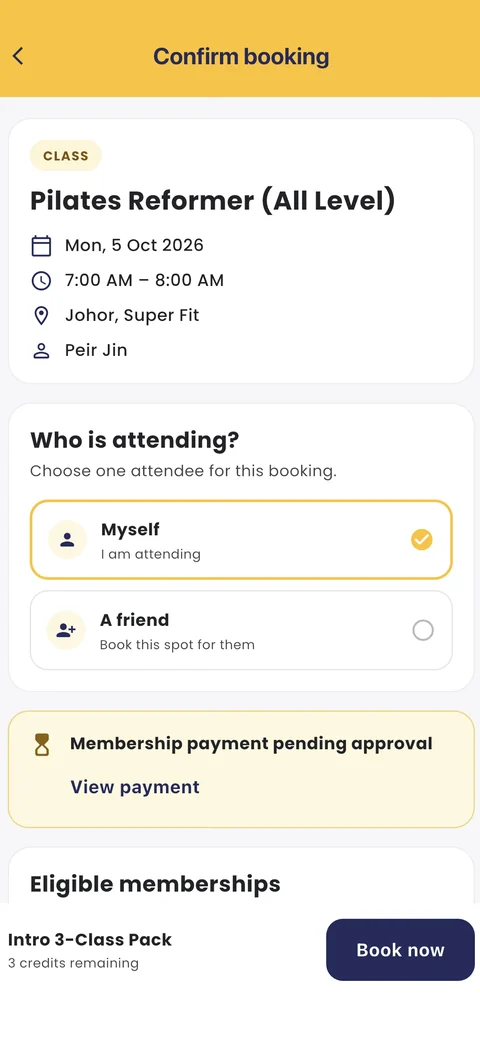
- Expiry: packs that last too long lose urgency. Give each pack enough time to use comfortably, and no more.
- Late cancellation: set a window, such as 12 hours, after which a cancelled class counts as used.
- No-shows: count a no-show as a used class, and say so clearly at checkout.
- Sharing: decide whether family members or friends can share a pack, and price shared packs a little higher.
- Freezes: allow a short extension for illness or travel, with a doctor's note or a small fee.
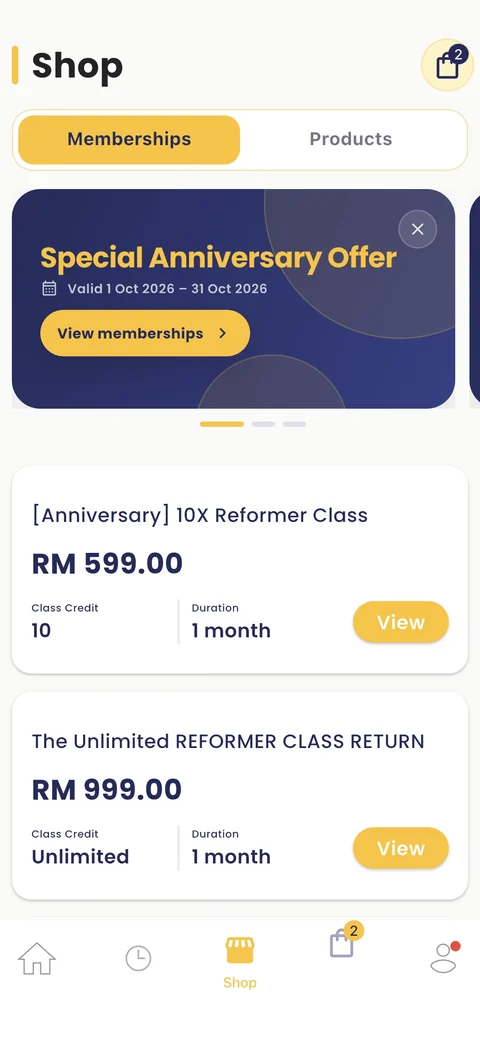
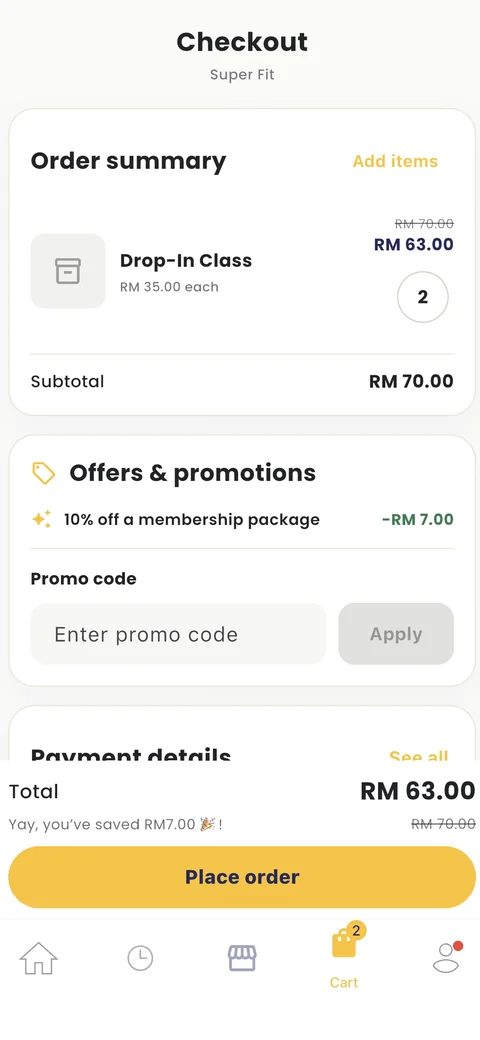
Rules only work if they are applied every time, by the system rather than the front desk. In Fitnow, late-cancel and no-show rules, pack expiry and promo codes run automatically when members book online in the app or on your booking site.

When and how to raise your prices
Review prices at least once a year, and sooner if rent or instructor pay rises. Give at least a month's notice, honour packs already bought, and let regulars buy one more pack at the old price. Raise drop-in and intro prices first, since they affect regulars least. If classes are often full with a waitlist, that is a clear sign you can charge more.
Frequently asked questions
How much is a reformer Pilates class in Kuala Lumpur?
Group reformer classes in the Klang Valley typically cost about RM60 to RM100 for a single class, and roughly RM50 to RM70 per class when bought in a pack. Prices vary by studio and change over time.
How much should I charge for a private Pilates session?
Private sessions in the Klang Valley typically cost around RM150 to RM260. A useful rule is two to three times your group reformer price, adjusted for the instructor's experience and your costs.
How much discount should Pilates class packs give?
Many studios discount packs by roughly 15% to 35% off the single class price, with bigger packs getting bigger discounts. Check that your largest pack's per-class price still covers your cost per client at a realistic fill rate.
Should I offer unlimited reformer memberships?
Be careful. Reformer spots are limited, so a few very regular members can block spots you need to sell. Capped monthly plans, such as 8 or 12 classes a month, are easier to manage.
How long should a Pilates class pack be valid?
Long enough to use comfortably at a normal pace and no longer. For example, 60 days for a 5-class pack, 90 days for 10 classes and around 180 days for 20 classes.
What you get with Fitnow
- Class packs, intro offers and capped memberships
- Pack expiry, late-cancel and no-show rules applied automatically
- Promo codes and payment by card, GrabPay or Touch 'n Go
- Reports on revenue, attendance and class fill