


To start a Pilates studio in Malaysia, register your business with SSM (RM60 a year for a trade name, or about RM1,000 to incorporate a Sdn Bhd), find a commercial space and get your local council premise and signboard licence, buy reformers or mats, hire certified instructors, then set your prices and booking system before you open. As a rough estimate, a small six-reformer studio needs around RM200,000 to RM500,000 to open, and a mat-only studio much less.
Most new owners are great instructors first and business owners second. That is normal. This guide walks through the seven steps in the order you will meet them, with typical costs in ringgit so you can plan. If you are writing a plan for a bank or partner, our Pilates studio business plan guide covers the document and the financial projections in detail.
Step 1: Decide what kind of studio you are opening
Your format decides your space, your equipment bill and your prices, so settle it first. Most Pilates studios in Malaysia fall into one of three models.
| Studio model | Typical space | Main equipment | Typical start-up (estimate) |
|---|---|---|---|
| Mat group studio | 600 to 1,200 sq ft | Mats, small props, sound system | RM40,000 to RM100,000 |
| Private and duet studio | 500 to 900 sq ft | 2 to 3 reformers, maybe a tower or chair | RM80,000 to RM180,000 |
| Group reformer studio | 1,200 to 2,000 sq ft | 6 to 10 reformers | RM200,000 to RM500,000+ |
Group reformer classes earn more per hour but cost far more to set up. A mat or private studio is a lower-risk way to build a client base before you add reformers. Pick the model your savings and your local market can support, not the one that looks best on Instagram.
All ringgit figures in this guide are typical estimates. Costs vary by city, landlord, supplier and exchange rate, and they change over time. Get at least three quotes for anything large.
Step 2: Register your business with SSM
You must register with the Companies Commission of Malaysia (SSM) before you trade. The two usual choices are a sole proprietorship or partnership, or a private limited company (Sdn Bhd).
- Sole proprietorship or partnership: RM30 a year with your own name, or RM60 a year with a trade name such as "Bloom Pilates". See the SSM table of fees. Simple and cheap, but you are personally liable for the business's debts.
- Sdn Bhd: about RM1,000 in SSM incorporation fees, plus a yearly annual return fee and the cost of a company secretary. It separates your personal assets from the business and is easier for investors and some landlords. Check current fees on the SSM website.
- After registering: open a business bank account, and register as an employer with EPF, SOCSO and LHDN before your first hire.
Ask an accountant which structure suits you. A reformer studio with a lease, staff and equipment loans often outgrows a sole proprietorship quickly.

Step 3: Find the right space
Look for a commercial unit approved for business use, with good air-conditioning, natural light if you can get it, parking, and a toilet and changing area. For a reformer studio, plan on roughly 50 to 70 sq ft of floor per reformer once you allow room to walk around each machine, plus reception, storage and changing space.
| Area | Typical rent (estimate, per sq ft per month) |
|---|---|
| Klang Valley, ground floor in a busy area | RM3 to RM8 |
| Klang Valley, upper floor shoplot | RM1.50 to RM4 |
| Penang | RM1.50 to RM4 |
| Johor Bahru | RM1.50 to RM3.50 |
Ground floor retail listings in Petaling Jaya currently sit mostly between RM3 and RM5 per sq ft, and upper floors are usually cheaper. MIDA's cost of doing business report also shows prime office rents in Penang and Johor Bahru well below Kuala Lumpur. Before you sign, ask for a rent-free fit-out period, check the landlord allows a fitness business, and confirm there are no complaints about noise from neighbours below.
Step 4: Get your local council licences
Your local council (PBT), such as DBKL, MBPJ, MBSJ, MBPP or MBJB, issues the premise licence and the signboard licence. Most councils ask for your SSM certificate, tenancy agreement, floor plan, photos of the premises and a fire safety (Bomba) support letter or certificate.
- Fees vary by council. Premise and signboard licences are often a few hundred ringgit a year, but some councils also require a separate gym or fitness licence. In Kuala Lumpur, DBKL cut its gym licence fee to RM10 per square metre from January 2026, down from RM50.
- Ask how they classify you. Some councils treat a Pilates studio as a fitness centre and others as a general business. Call the licensing counter before you commit to a unit.
- Allow one to three months. Apply while the fit-out is under way so the inspection can happen as soon as the studio is ready.
Step 5: How much does a Pilates reformer cost in Malaysia?
A studio-grade reformer from an established international brand typically lists at around USD3,000 to USD7,500, which is roughly RM12,000 to RM33,000 each before shipping, import costs and installation. Lower-priced reformers made in the region are also sold locally, so compare several suppliers.
- Check spare parts and service. Springs, ropes and straps wear out. Ask who stocks parts in Malaysia and how fast they can fix a machine.
- Try before you buy. Teach a class on the model you are considering. Carriage feel and height matter to clients.
- Ask about financing. Some suppliers and banks offer equipment financing or leasing, which spreads the cost.
- Budget for the small things. Mats, boxes, rings, balls, a sound system and storage add up quickly.
Step 6: Hire certified instructors
Look for instructors with a recognised comprehensive or reformer certification for machine classes, and mat certification for mat classes. Ask them to teach a trial class to you and a few friends before you hire.
Decide early whether instructors are employees or freelancers, and how you pay them: per class, per client or a revenue share. Our guide on how to pay fitness instructors compares the options. For employees, budget for the national minimum wage of RM1,700 a month, plus employer EPF of 13% for wages of RM5,000 and below, and SOCSO and EIS contributions. Together those statutory contributions add roughly 15% on top of salary for most Malaysian employees.

Sample start-up budget for a six-reformer studio
Here is an example budget for a 1,500 sq ft group reformer studio in the Klang Valley, with rent assumed at RM4 per sq ft (RM6,000 a month). It is an example to help you plan, not a quote.
| Item | Example range |
|---|---|
| SSM registration, licences, Bomba and professional fees | RM3,000 to RM8,000 |
| Rental and utility deposits (about 3 months) | RM18,000 to RM20,000 |
| Fit-out: flooring, mirrors, lighting, air-conditioning, changing room, reception | RM60,000 to RM150,000 |
| 6 studio reformers, delivered and installed | RM75,000 to RM200,000 |
| Small equipment, props and sound system | RM5,000 to RM15,000 |
| Branding, website, photos and launch marketing | RM8,000 to RM20,000 |
| Working capital: 3 months of running costs | RM45,000 to RM90,000 |
| Total | RM214,000 to RM503,000 |
Do not skip the working capital line. New studios rarely fill classes in the first month, and you still pay rent and instructors while you build up.
Step 7: Set your prices and booking system before you open
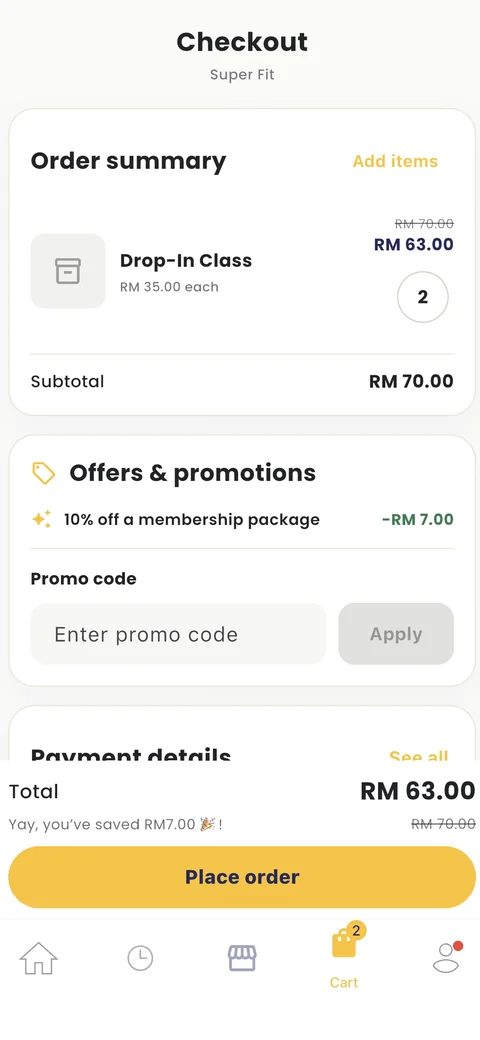
Decide your price ladder before opening day: an intro offer, single classes, class packs and private sessions. Our guide to pricing Pilates classes shows how to work out a price from your cost per class. Then pre-sell founding member packs four to six weeks before you open, so you start with cash and full first classes.
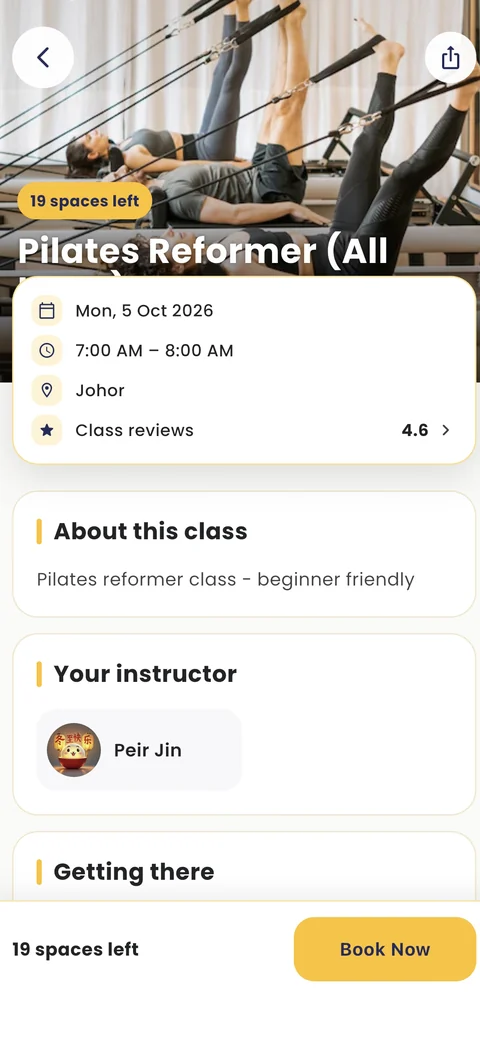
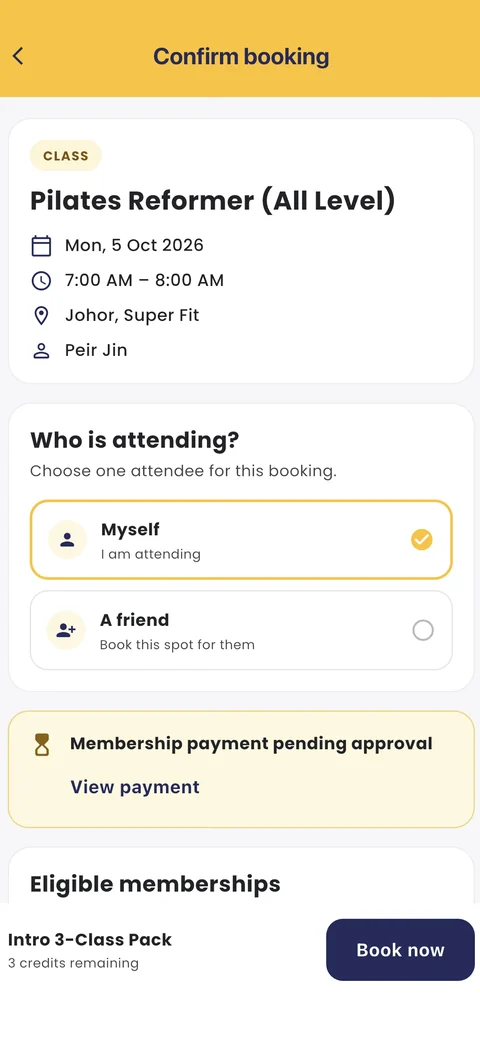
Set up your booking system at the same time. Class capacity should match your reformer count, with a waitlist for full classes, a late-cancellation rule, and digital waivers that new clients sign before their first session. Fitnow handles this in one system, with a member app and booking website for Pilates studios, and you can try it free for 30 days while you prepare to launch.
Your opening checklist
- Choose your studio model and write a simple business plan with numbers.
- Register with SSM and open a business bank account.
- Sign a lease only after the council confirms the unit can be licensed.
- Order reformers early, since shipping can take weeks.
- Apply for premise, signboard and any fitness licence, with your Bomba documents.
- Hire instructors and register as an employer with EPF and SOCSO.
- Set up prices, packs, waivers and online booking.
- Pre-sell founding packs and run a soft-opening week.
Frequently asked questions
Do I need a licence to open a Pilates studio in Malaysia?
Yes. You need SSM business registration and a premise and signboard licence from your local council. Some councils also class a Pilates studio as a gym or fitness centre and require a separate licence, so check with the council before you sign a lease.
How much does it cost to open a Pilates studio in Malaysia?
As a typical estimate, a mat-only studio can open for around RM40,000 to RM100,000, while a six-reformer studio often needs RM200,000 to RM500,000 including fit-out, equipment and three months of working capital. Costs vary by city and supplier.
Should I start with mat or reformer Pilates?
Start with the format your budget and market can support. Mat and private studios cost far less to open and let you build a client base, while group reformer classes earn more per hour but need a much larger investment.
How many reformers do I need to start a studio?
Your reformer count is your group class size. Work out how many paid visits a week you need to cover costs, then choose the number of reformers that lets you reach that with classes you can realistically fill.
How long does it take to open a Pilates studio?
Plan for roughly three to six months from signing a lease to opening. Council licences can take one to three months, fit-out several weeks, and imported reformers can take weeks to arrive.
What you get with Fitnow
- Class and private session booking, with capacity set to your reformers
- Intro offers, class packs and memberships with online payment
- Waitlists, late-cancel rules and digital waivers
- Instructor payroll per class, per client or revenue share